
Smithtown Resident Lookup Record Coverage
A Smithtown resident lookup does not produce one complete identity file. Each record answers a smaller question. The tax account can identify an owner and correspondence field. A deed can tie a party to a recorded transfer. A court index can show a party role. A voter match is limited confirmation. A vital index can distinguish family events.
Start with the record that best matches the fact already known. An address can be anchored to a parcel, while a name with a middle initial may be better suited to a court, business, or license query. Dates are essential. A record dated years ago may help a family-history trail without saying anything about the present. The coverage table marks both the evidence each source can offer and the access limits that apply.
| Smithtown record | What it can confirm | Custodian or search | Access limits |
|---|---|---|---|
| Tax and assessment account | Owner, tax-map number, situs and correspondence fields | Smithtown BAS tax search | Public search; a mailing field is not proof of presence |
| Parcel geography | Parcel, town, hamlet, ZIP, districts, and adjacent polygons | Suffolk County GIS Viewer | Reference map, not a legal survey |
| Recorded document index | Recorded transfer, lien, map, or filing connection | Suffolk County Clerk search | Index is free; images and certified copies have separate routes |
| Registration confirmation | Limited registration and poll-site match | New York State Voter Lookup | Protected-voter and identifying-data limits apply |
| Local civil case index | Party role, court, filing, and status fields | WebCivil Local | Sealed and sensitive matters remain restricted |
| Vital record path | Family event or historical genealogy distinction | Smithtown Town Clerk and New York State Department of Health | Recent copies have eligibility rules |
| License or filing | Credential, status, or organizational affiliation | NYSED verification and County Clerk business search | Public fields vary by source |
Note: A strong identity check compares two independent, dated records instead of treating one search result as a complete answer.
Smithtown Resident Lookup Cross-Checks
Use a staged method to avoid joining records for two different people. Normalize a maiden name, married name, middle initial, suffix, apostrophe, hyphen, trust, estate, or organization form. The County Clerk allows surname searching and search preferences such as Starts With, Contains, and Exact. The Smithtown tax search uses one field at a time, so run an owner search and an address search separately rather than expecting an intersected result.
Next, establish a geography anchor. Keep the parcel’s situs address, its tax-map number, the owner field, and the mailing field in separate notes. Then compare a second source that has an independent date or role. A court party plus a town name, a deed plus a tax-map number, or a license plus a known middle initial can help distinguish a namesake. Do not merge records just because a surname and ZIP match.
- Record the name variants, known address wording, hamlet or postal label, and the date range that needs confirmation.
- Use the Smithtown tax search or the county GIS viewer to identify the parcel and tax-map context when an address is known.
- Search the County Clerk index for a dated deed, mortgage, business certificate, or other appropriate filing connected to the name.
- Check an independent court, license, voter, vital, obituary, or local-history source for the same name, geography, and time period.
- Ask the relevant custodian how a factual index error is corrected when reliable records conflict.
- Docket
- The court’s running case record, which can identify a case number, parties, dates, and status without necessarily giving every paper in the case.
- Index and image
- An index lists searchable record details. An image is the underlying document, which may require a subscription, counter request, fee, or redaction review.
- Certified copy
- A copy issued by the custodian with its certification. Eligibility, format, and charges are controlled by the office holding that record.
Smithtown Resident Lookup Court Search
Smithtown’s local civil path is Suffolk District Court’s Fourth District in Hauppauge. Suffolk District Court WebCivil instructions identify the court suffix as SM. In WebCivil Local Party Search, a person can search a party name or enter an index number, then narrow by court, case type, filing year, status, attorney, judge, future appearances, and output format.
CV, CC, and SC case information filed since 2008 is generally available through the local-court information path. LT material is generally available only through 14 days after final appearance. Separate NYSCEF case-search instructions cover participating e-filed matters and use different fields. Court information is not a complete personal history, and adoption, juvenile, sealed, and many family matters have additional limits.
| Party Name | Optional text field; test surname-only and spelling variants. |
|---|---|
| Index Number | Optional structured search. The full form includes case type, number, year, and court suffix; the instructions also show a shortened 44-06 form. |
| Court and type | Select one or more courts and an applicable CV, CC, LT, or SC category. |
| Year and status | Use filing-year choices and Open or All status to narrow a result. |
| Output | The portal offers HTML or PDF result lists. |
A public WebCivil result can show an index or case number, plaintiff and defendant names, party role, case type and status, court, filing date, future appearance information, and judge or attorney links where indexed. That is an index inventory, not a guarantee that every docket entry or paper can be viewed.
Smithtown Resident Lookup Voter Limits
The New York State Voter Lookup is a limited confirmation tool, not a Smithtown directory of everyone at an address. Its normal workflow uses Suffolk County, last name, first name, date of birth, ZIP Code, and address information. The form requires JavaScript and cookies. A ZIP is only a postal narrowing field, so it is not a town-boundary test. The public record never reveals ballot choices.
Election Law protections exclude driver-license and non-driver ID information, Social Security data, and facsimile information from public inspection. Protected voters and Address Confidentiality Program participants have separate procedures. A full voter-file request has a different route and must include an elections-purpose statement under Election Law §3-103(5). For an individual record question or correction, the county elections office handles local registration and voter-card requests.
Note: A non-match may reflect a protected, inactive, changed, or differently indexed record and does not prove a person never lived in Smithtown.
Smithtown Resident Lookup Vital Routes
Birth, death, marriage, and divorce records use different custodians and rules. For a recent Smithtown event, begin with the Smithtown Town Clerk, the local registrar for town-held birth, death, and marriage records. The New York State Department of Health vital-records route holds statewide copies outside New York City. Divorce certificates are state-held from 1963 forward, while older divorce files and certificates may require a County Clerk or court route.
Recent certified copies are not an unrestricted name-search product. New York’s genealogy route generally opens births after 75 years, deaths after 50 years, and marriages after 50 years when both spouses are known deceased, subject to stated direct-line and death-proof exceptions. Department of Health genealogy guidance and its DOH-4384 application explain the mail route. The New York State Archives provides indexes and research guidance rather than ordinary certificates.
Smithtown Resident Lookup License Checks
A state license or public filing can confirm an affiliation, credential status, or dated organizational connection. It does not establish where someone lives. The NYSED online verification search reports public name, profession, license number, location, original-license date, registration status, and discipline summaries where available. It searches one profession at a time. The research notes that a last name needs at least three letters, and punctuation in names such as Mc or O’ can matter.
The eAccessNY name search is a separate state license route with individual last and first name fields. The state business-entity database can show an entity’s name, formation date, jurisdiction, county, service address, agent, status, and active filing history. For local assumed names, the Suffolk County Clerk Business Certificates tab accepts business name, optional last name and city, and a date range.
The eAccessNY individual and organization search is one official license-verification path.
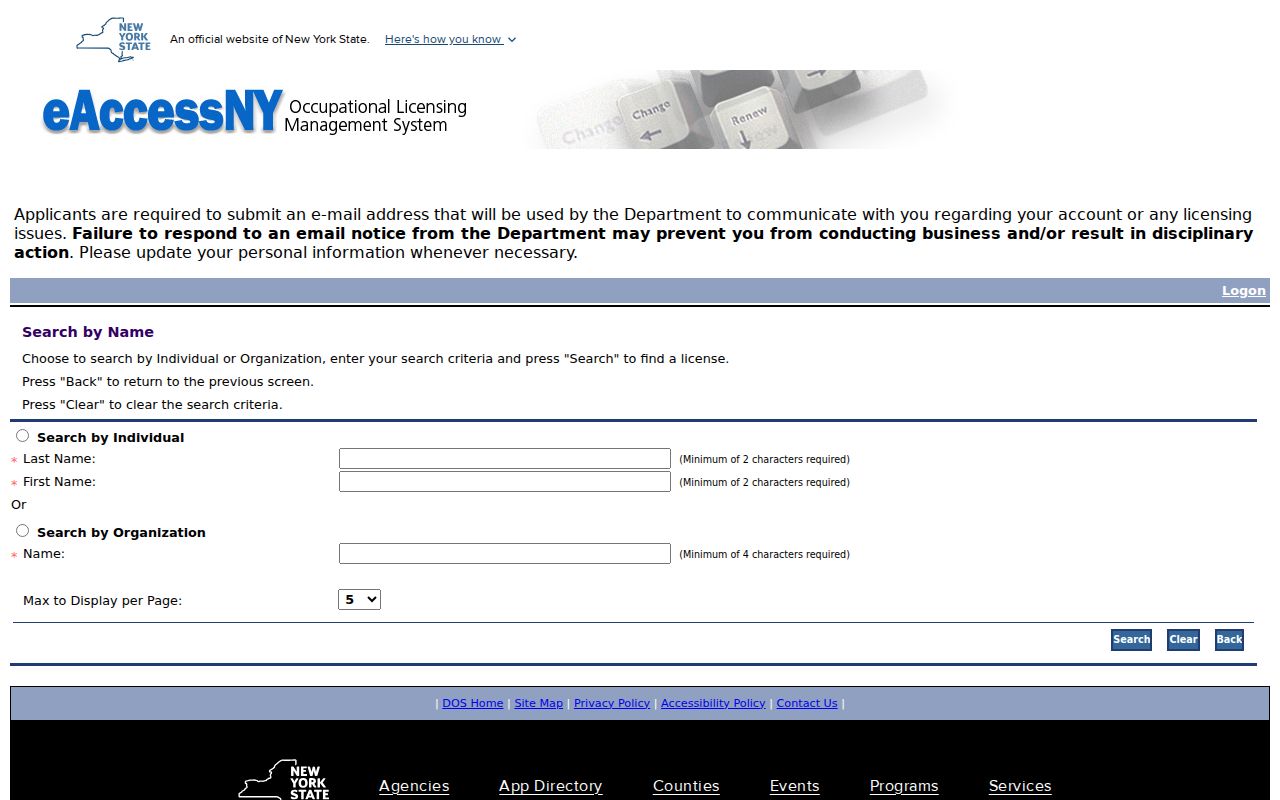
A license result should be compared with a date and an independent Smithtown record before it is tied to a particular person.
NYSED’s professional verification search provides the other state credential route used in this lookup.
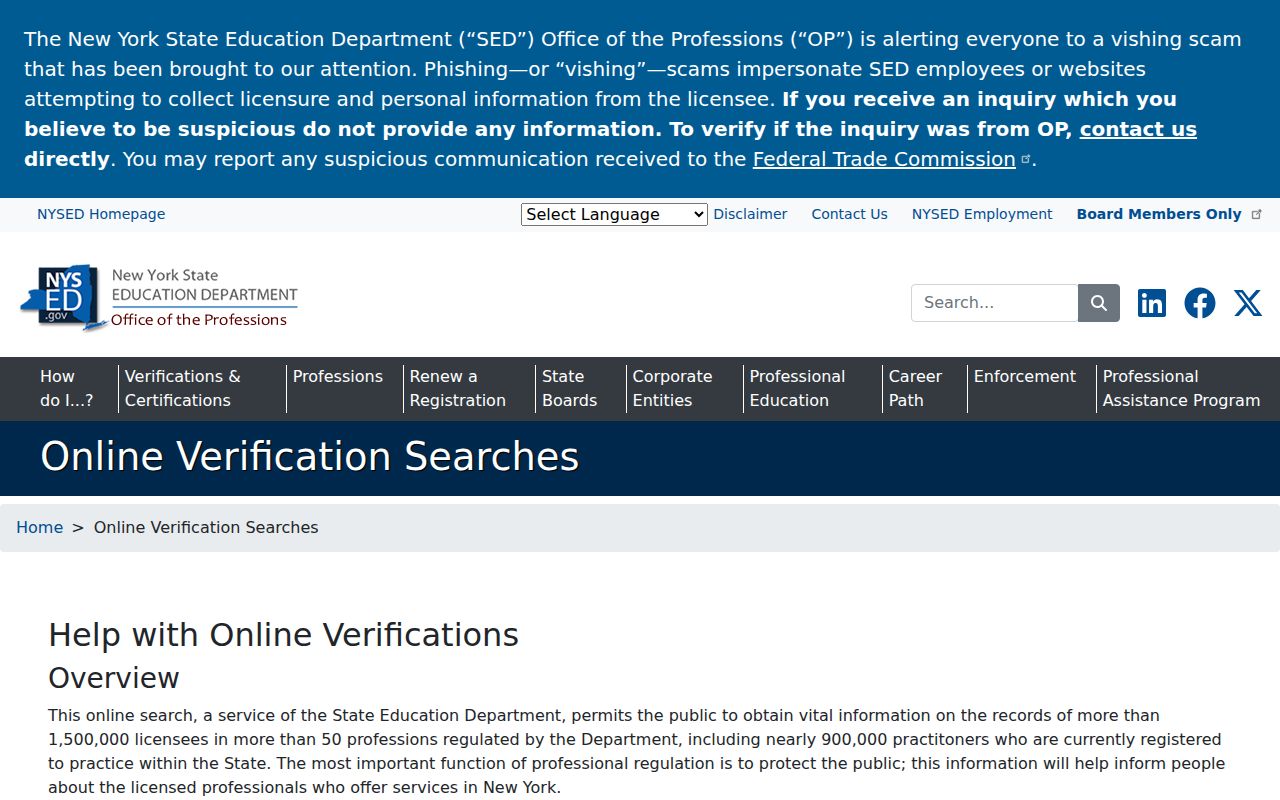
Use the profession filter and the displayed license details to separate matching names, then verify the result through the responsible board if needed.
Smithtown Resident Lookup Adoption Route
For a birth-parent question, use New York’s official adoption registry and adoption-record process instead of treating ordinary public indexes as a substitute. The Department of Health program covers people born or adopted in New York who are 18 or older and offers non-identifying, identifying, and medical-information paths. Eligibility and consent rules control what can be released. A request should follow the state program’s current instructions and should respect the privacy of every person named in the record.
For another family-history question, yearbooks, library newspapers, obituaries, deeds, census records, and probate documents can create a dated trail. A yearbook offers a school-and-time anchor, not a current address. An obituary may identify family relationships or a last residence, but it still needs corroboration. The Smithtown Library Long Island Room is a local reference path for newspaper and historical-material questions.
Smithtown Resident Lookup Privacy Limits
New York handles privacy record by record. The address confidentiality program gives qualifying participants a substitute mailing address and mail-forwarding service. Actual residential locations are confidential except through specified court or law-enforcement process. The state also uses protected-voter and confidential-registration procedures. Do not use a public record, a map layer, or a failed search to try to reconstruct a protected location.
FOIL can request existing nonexempt records, but it does not require an office to identify a person or answer a research question. The New York Freedom of Information Law guide explains that a request should identify the agency, record, date, address, and format. For a factual error, contact the office that controls the source: the Smithtown Assessor for tax data, the Suffolk County Board of Elections for registration data, the Suffolk County Clerk for index questions, a court clerk for docket issues, or the licensing board for credential data.
Lawful use. Use a Smithtown resident lookup for personal, family-history, civic, or records research. Do not use information to stalk, harass, intimidate, or harm anyone.
Smithtown Resident Lookup Boundaries
Some state sources are narrow by design. The New York State DOCCS incarcerated-individual lookup searches the state correctional system by name, DIN, NYSID, or birth year. It is not a general identity tool and should not be used to make claims beyond the status the official source provides. New York’s official criminal-history record-review route is for a person’s own fingerprint-based record, not a public third-party name search.
When an official online trail stops, use the custodian’s counter, a narrow FOIL request for an existing nonexempt record, or a library and archives reference request. A state genealogy guide can point to land, court, military, naturalization, probate, maps, and vital-index paths. An unresolved result is better recorded as unresolved than forced into a match.
The DOCCS incarcerated-individual lookup shows the separate state-system search referenced above.
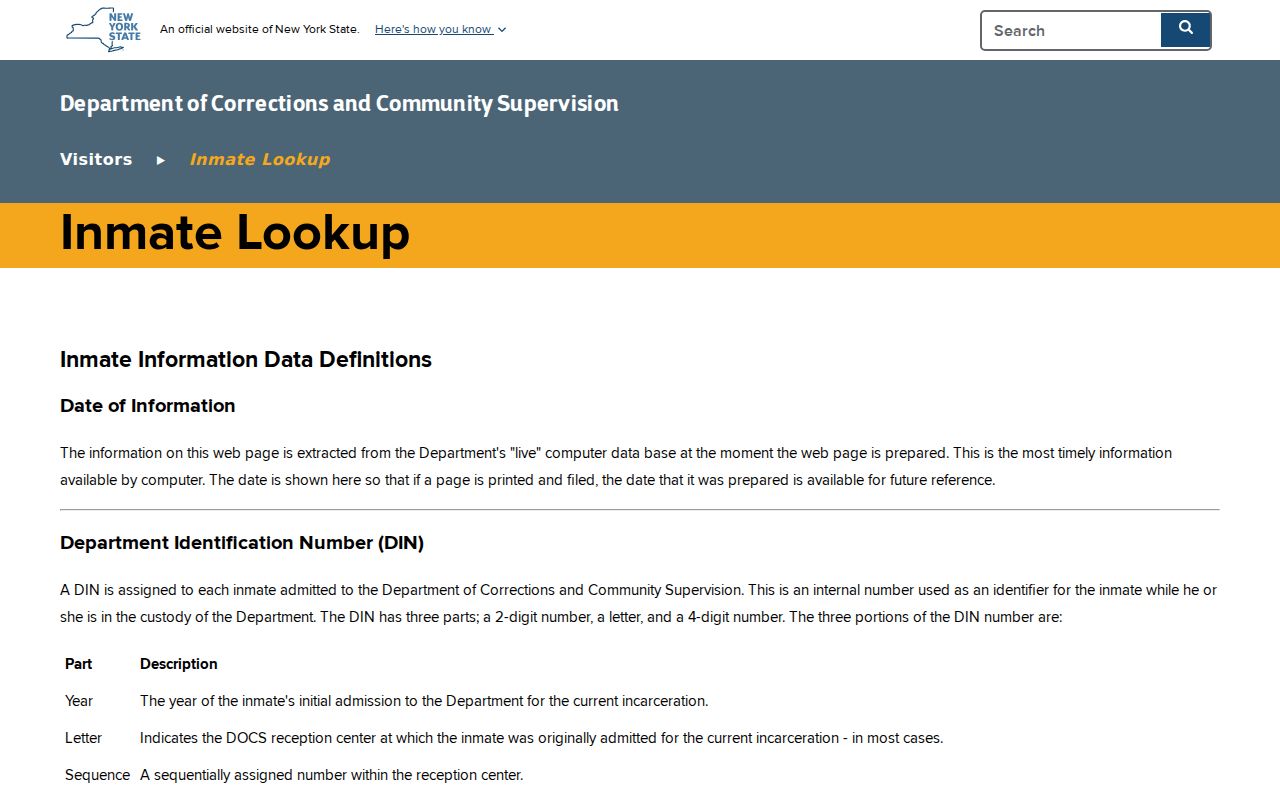
This specialized source should remain separate from Smithtown parcel, voter, court, library, and vital-record research.